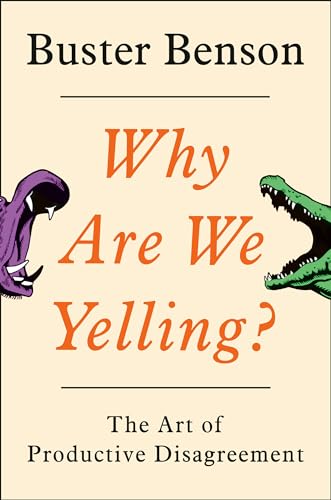
Why are we yelling? : the art of productive disagreement / Buster Benson.
Material type: TextPublication details: New York: Portfolio Penguin, c2019.Description: 277 pages : illustrations ; 22 cmISBN:
 - 9780525540106
- Why are we yelling? :
- 158.2 23
- BF637.I48 B46 2019
| Item type | Current library | Collection | Call number | Status | Barcode | |
|---|---|---|---|---|---|---|
 Books
Books
|
GESM Library Main Library | English Non-Fiction Adolescent-Adult | ENA 158 BEN | Available | E0006883 |
Includes bibliographical references and index.
"Does this sound familiar? You walk away from an argument and suddenly think of all the brilliant things you wish you'd said? You avoid family members and colleagues because of bitter, festering tension that you can't figure out how to address? Now, finally, there's a solution: a secret that frees you from the trap of unproductive conflict and pointless arguing forever. If the threat of raised voices, emotional outbursts, and public discord makes you want to hide under the conference room table, or if you're simply sick of unresolved arguments that never produce useful results, you're not alone. Conflict, or the fear of it, can be devastating. And the process of minimizing, deflecting, or avoiding difficult people can leave you brimming with repressed emotions. But as this powerful book argues, conflict doesn't have to be unpleasant. In fact, properly channeled, conflict can be the most powerful tool we have at our disposal for deepening relationships, solving problems, and coming up with new ideas. As the mastermind behind some of the highest-performing teams at Amazon, Twitter, and Slack, Buster Benson spent decades facilitating hard conversations in stressful environments. He found that even smart, eloquent people struggled to stay calm and keep their heads clear when differences of opinion arose. So he set out to find a better way to argue, staging a succession of experiments and informal debates, and studying the participants closely. He took note of the scripts people defaulted to and the chain reactions they caused. Slowly, patterns began to emerge. Buster's findings shattered his assumptions about what makes some arguments productive and others not, and dramatically improved his relationships at work, with his wife, and with strangers online. In this book, Buster reveals the psychological underpinnings of awkward, unproductive conflict, and the critical habits anyone can learn to avoid it. Armed with a deeper understanding of how arguments work and why, you'll be able to: * Remain confident when you're put on the spot * Diffuse tense moments with a few strategic questions * Facilitate creative solutions even when your team has radically different perspectives * Get through to the most stubborn people by understanding their motivations Freed of your fear of disagreement, you'll find yourself eager to engage with intimidating people and uncomfortable ideas. You'll end up having fewer repetitive, predictable fights, not because you're avoiding or squashing them, but because you're finally able to identify your biases, listen with an open mind, and communicate well. As your confidence grows, you'll shake off lingering memories of interactions that made you feel tongue-tied or incapable, knowing that it's in your power to steer the conversation wherever you want it"--
There are no comments on this title.